Hamilton has two very different kinds of commercial door problem, and they show up on two very different kinds of building. There is the older main-street retail frontage, with aluminum and glass entrances installed into masonry openings that have been settling for a century. And there is the industrial and warehouse stock toward the harbour and along the arterial routes, where the doors are steel, heavy, and expected to take abuse.
The failures are predictable once you know which category a building falls into. What follows is the pattern, and what it is usually worth checking before a door strands you.
Older retail frontage: the frame moves, the door gets blamed
An aluminum entrance is a precise assembly set into an opening that is not. When the masonry above and around it shifts, even slightly, the frame carries that movement and the door stops fitting the way it did.
The symptoms arrive in a specific order. First the door needs a little more pull to latch. Then it starts to bind at one corner. Then the closer, which has been quietly working harder for two years, gives up. The owner calls about the closer, because that was the last thing to fail, and the closer was never the problem.
Why replacing the closer alone rarely lasts
A closer is sized and set for a door of a particular weight moving through a particular amount of friction. Drop a new closer onto a racked frame and it will work for a while, then wear out faster than the last one, because you have handed it the same job with the same handicap. The diagonal measurements of the door leaf are the first thing worth checking on any storefront entrance that has started to bind.
Industrial openings: the abuse is deliberate and constant
Steel personnel doors on warehouses and shops fail from impact and from being propped. Pallets clip them, carts hit them, and they get wedged open in summer so that the frame takes the load of a door held out of position for weeks at a time.
Hinges are the first casualty, then the frame at the hinge side, then the latch and strike as the geometry drifts. On doors used as the main traffic route between two spaces, the case for a continuous geared hinge rather than three butt hinges is easy to make: it spreads the load along the full height instead of concentrating it at three points, and it removes the most common single failure point on a busy opening.
Bottoms rust out before anything else
The lower few inches of a steel door and frame take salt, meltwater and floor washing. Corrosion there starts inside the profile and shows up late. By the time paint is bubbling at ankle height, the section behind it is usually thinner than it looks. Checking the bottom corners of exterior steel frames in autumn, before the salt starts, is one of the higher-value inspections in a building like this.
Exit doors are the ones that create liability
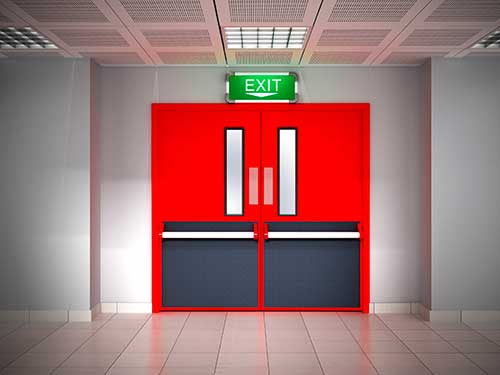
Every commercial building has doors that are required to let people out reliably, and those are precisely the doors nobody uses day to day. A rear exit that is opened twice a year will sit with a seized closer, a latch that no longer engages its keeper, and hardware that has never been cycled enough to reveal that it is stiff.
The requirement is not complicated: the door has to open in the direction of travel, without a key, in a single motion, and it has to close and latch on its own if it is a rated assembly. What defeats it in practice is mundane — a chain through the panic bar, a bolt added after a break-in, snow piled against the outside, or a closer with no fluid left. Anyone who works on fire exit doors will tell you the hardware is rarely the hard part. Getting the opening kept clear and the closer maintained is.
Panic hardware has a wear pattern
Push bars are mechanical and they do wear. The dogging mechanism, the latch bolt, and the vertical rods on two-point devices all have play that increases with use. A panic device that needs a hard shove, or that latches only sometimes, is at the end of its serviceable life rather than in need of adjustment.
Weather on the escarpment side
Buildings on either side of the escarpment get meaningfully different wind exposure, and wind is what decides whether a door latches. An entrance that closes beautifully in still air can fail to latch in a crosswind, because the closer’s latching action is the weakest part of its stroke and wind pressure is working against it precisely at the end of the swing.
Where this is a recurring problem, the answer is usually the closer’s latch speed and backcheck settings rather than a heavier closer, because a heavier closer makes the door harder to open for everyone. On genuinely exposed entrances, a power operator resolves both sides of it.
What to put on a maintenance list
Four checks, twice a year, catch most of what turns into an emergency. Cycle every exit door by hand and confirm it latches on its own. Look at the bottom corners of exterior steel frames for bubbling paint. Check that hinge screws are seated rather than standing proud. And confirm that no door has acquired an aftermarket bolt or chain since the last look.
The reason to do this on a schedule rather than on complaint is that the failures are cumulative. A door that has started to bind will keep binding harder until something breaks, and the thing that breaks is usually the expensive part. Having whoever handles your commercial door repair in Hamilton look at all the openings in one scheduled visit is considerably cheaper than three separate callouts, and it means the person looking at the doors has seen them before.
When it does become urgent
Some situations are not maintenance items. A door that will not lock at closing time, a broken storefront panel, a jammed exit device on an occupied building, or an overhead door stuck partway are all reasons to get someone out rather than wait for the morning. In those cases the first job is making the opening secure and safe, and the permanent repair follows once parts are in hand. Knowing in advance who handles emergency door repair for your building, and having the opening details on file, is what shortens that night.
Frequently asked questions
How often should commercial doors be inspected?
Twice a year suits most buildings, timed before winter and after it. High-traffic industrial openings benefit from more frequent checks, and rated exit doors should be cycled and confirmed to latch more often than that, because their whole purpose is to work on a day nobody planned for.
Is it worth repairing an old aluminum storefront entrance?
Usually yes, if the frame can be brought back to square. Aluminum profiles are durable and the consumables are the glass, the hardware and the seals. Replacement makes more sense when the profile is obsolete, the frame is beyond correction, or the entrance is being reconfigured anyway.
Can a propped-open door really damage the frame?
Yes. Holding a heavy steel door at the end of its swing for weeks puts a sustained load on the hinges and the hinge-side jamb that they were not designed to carry continuously. Hold-open hardware exists precisely so that doors can be kept open without loading the hinges that way.
What is the most commonly missed item on a commercial opening?
The threshold. It is underfoot, it wears, its seals shrink, and a dragging sweep quietly adds resistance that everyone then blames on the closer.